Tampilkan postingan dengan label made. Tampilkan semua postingan

Jumat, 25 Maret 2016

I’M READING A BOOK about one of the most fascinating stories of survival at sea in a small boat, one that ranks right up there with Captain Bligh and Shackleton and Survive the Savage Sea.

It’s called All Brave Sailors, by J. Revell Carr (Simon & Schuster), and it deals with the sinking of an English tramp steamer, the Anglo-Saxon, after a surprise attack by a German raider ship (a powerful warship disguised as a neutral merchant freighter) during World War II.

Only seven of the Anglo-Saxon’s crew managed to escape from the sinking ship in a clinker-built 18-foot open gig. They had practically no food, just a few gallons of water, and no navigation equipment apart from a compass.

Of those seven, only two survived a 70-day sail in the gig from the eastern side of the North Atlantic to Eleuthera Island in the Bahamas, where they became instant celebrities.

They ran out of food and water fairly quickly, and a large part of the book explains how their ravaged bodies coped with the situation. What strikes me, however, is that they made no attempt to catch plankton, an act which surely would have saved more lives.

Dr. Alain Bombard demonstrated the abundance of life-giving plankton in his Atlantic crossing in his raft, L’Heretique. Before that,  William Beebe, the famous naturalist, writer, and explorer, undertook the laborious task of counting the number of the tiny creatures he caught in a net. Here’s his account, from The Arcturus Adventure (G. P. Putnam’s Sons):

“One dark moonless evening I put out a silk surface net, the mouth of which was round and about a yard in diameter. At the farther end of the net a quart preserve jar was tied to receive and hold any small creatures which might be caught as the net was drawn slowly along the surface of the water. This was done at the speed of two knots and kept up for the duration of one hour.

“When drawn in, the net sagged heavily and we poured out an overflowing mass of rich pink jelly into a flat white tray."   

Most of the these individuals were primitive crustaceans, which make plankton a rich, nourishing food, even raw.

It’s also worthwhile repeating that all these creatures that we call plankton were caught at the surface on a dark night. Beebe repeated the experiment in full daylight and caught only about 1,000 individuals instead of 40,000,000.

“Plankton will have nothing of the sun or even of moonlight,” he observed, “and remains well below the reach of the stronger rays.”

You might want to try dragging a net, or even a shirt sleeve knotted at the end, next time you’re at sea on a dark night. You never know when this knowledge might come in useful.

Today’s Thought
Shipwrecked men in an open boat, if their lot is cast on waters rich in plankton, never need to starve to death if they can manage to drag an old shirt, net, fashion, through the water at night.— William Beebe, The Arcturus Adventure

Tailpiece
“How’s your son getting on these days?”
“He just turned 16. He kissed his first girl and started smoking.”
“Wow! Must have been some kiss.”
Read More..

Senin, 21 Maret 2016

Remember the trailer? This one, the one that almost killed us?


We left the shantyboat hull pretty complete. Now that the boat is ready to be flipped, we turn our attention back to the trailer.

It is really a rusty, janky old thing. Ive owned it for fifteen years or so, or sorta owned it since I bought it with Sean for our Burning Man theme camp, the Costco Soulmate Trading Outlet. Its been stolen and recovered, broken and repaired on the road. We used to haul that thing back and forth loaded to the gills over the Sierra Nevada Mountains, taking our lives into our own hands. Then we realized that if we stored it in the desert, we could save wear and tear on our mortality. So there it stayed for about ten years.

When the camp realized it could buy a shipping container and have it dropped off at their campsite every year without the hassle of dealing with That Trailer, the poor thing got abandoned for a few years out in the Nevada wilds. You remember that I drove out to the desert with Alex to rescue our friend the trailer, a trip with nearly fatal results.

So here it is, a 20 foot flatbed, maybe suited to my shantyboat, maybe not, needing suspension work, a coat of paint, deck repair, and maybe some repair welds.


The first thing I did was fire up my cutting torch and cut off the weird distinctive triangle things, and ground down the cuts. I always assumed they were there as a token gesture to structural reinforcement.


I replaced all the deck bolts that had rusted through, grinding off and replacing any that had loosened. The deck needed about 50 new bolts. This alone made the deck much more stable.


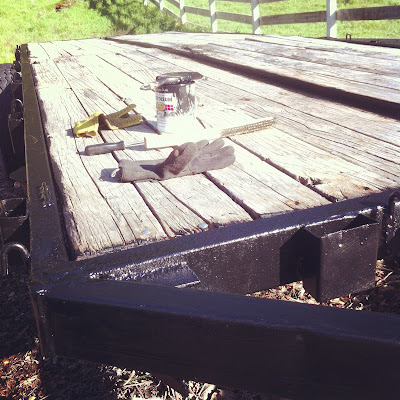
I gave all the metal on the entire trailer, top and bottom, a new coat of Rust-Oleum. I had to get suited up to prevent myself from being painted too thoroughly, climbing under the trailer and applying paint overhead.

It looked pretty good when I was done. Though crawling around under the trailer, I saw several places where the metal was cracked, principally around the lateral beam that joined the two pairs of leaf springs on either side.

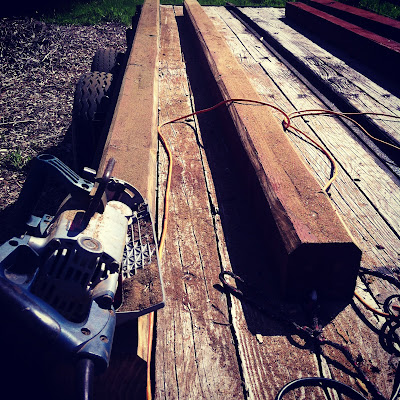
For a while, Id been sweating how to make the skids that would hold up the boat. I considered using recycled railroad ties since I could get them for free at the local trainyard, but their height and condition were too inconsistent. Eventually I got a ridiculous deal from a friend at the local lumberyard who found me some 6x6 treated lumber seconds that had a barely perceptible twist or were split a bit at one end.


I positioned the skids so one set would lie just inside of the skegs, and the other set so they lay at the outside edge of the trailer, as far out as could be secured. I figured this would support the boat along the stringers as well as give it side-to-side stability, something I thought would be extra important as we were trucking down the highway.


I drilled bolt holes through the skids and into the support brackets under the trailer.


I put big long 8 inch carriage bolts through the skids. For extra measure, I painted the bottom and tops of the carriage bolts. Lawrence joined me for a bit and serenaded me with excellent banjo tunes.


To prevent the skids from damaging the surface of the hull, I chamfered the sharp edges of the skids with my skill saw.


I cut the ends of each skid at an angle to guide the skegs while the boat was being trailered. Though honestly, I dont think the skegs at the back of the boat will be anywhere near the skids, since that end of the trailer will be deep under water and the back of the boat high above it during a boat launch or trailering. But it seemed like a good idea.


Then I covered the skids with indoor/outdoor low-pile carpet, stapling and using roofing nails at the edges.


The result was surprisingly legit looking.


Then Jen and I sat on the trailer and had a beer.  Something about this trailer makes you want to sit on it and have a drink.  Whats that about?

Next, the superhero of heavy duty welding flies the trailer high into the sky and melts it with his heat ray vision!


Read More..